
Warren County Arrest Court Records
After an arrest in Warren County, Indiana, two records tracks may exist at the same time. The Warren County Jail record is created around custody: who was received, the arresting agency, when the person was booked, whether a release date appears, and whether a bond or hold is visible. The court record begins when a criminal case is filed in Warren Circuit Court. That case file is where the formal charges, case number, public hearings, orders, plea entries, dismissals, convictions, and sentencing information are tracked.
The charging authority is the Warren County Prosecutor's Office. Indiana uses prosecuting attorneys rather than district attorneys, and the Warren office represents the State of Indiana in felony and misdemeanor prosecutions for crimes committed in Warren County. Prosecuting Attorney Bonnie Adams and Deputy Craig Jones are listed by the county, and the office describes work that includes filing criminal charges and infractions, assisting investigations, obtaining subpoenas, conducting grand juries, victim assistance, restitution, and seizure or forfeiture matters.
That distinction matters because the charge listed during booking is not always the same charge that later appears in MyCase. A probable-cause arrest can be followed by different filed counts, amended counts, dismissed counts, or diversion discussions. For custody and booking details, use jail inmate records. For booking photos and public-image limits, use jail roster mugshots. For court records after a jail arrest, use MyCase, Warren Circuit Court, the Clerk, and the prosecutor's filed charging documents.
Find Warren County Court Records
Warren Circuit Court points the public to its Find My Case & Hearing page. That local page explains that MyCase searches non-confidential Indiana Odyssey cases, including Warren Circuit Court, while the public hearing calendar shows trial-court schedules for the past seven days and the next four weeks. Confidential cases, special judge cases, and administrative matters may not display online.
The Indiana MyCase portal is the starting point for public court records after an arrest. Search by defendant name when no case number is known, then verify that the court is Warren Circuit Court and that the filing date, party name, and date of birth details match the person booked into jail. If a case number appears on jail paperwork, bond paperwork, a summons, or a clerk receipt, use that number because it reduces false matches.
- Open MyCase or the Warren Circuit Court Find My Case & Hearing page.
- Search by defendant name, case number, citation number, or cross-reference number.
- Confirm the court is Warren Circuit Court for a Warren County offense.
- Open the case and read the charge list, docket entries, bond orders, hearings, and disposition fields.
- If a public document is not online, contact the Warren County Clerk because court documents must often be obtained from the county where the case is heard.
The Indiana Judicial Branch public-records page also routes users to MyCase, court records, the county jail offender locator, the sex offender registry, and the Indiana Department of Correction locator. It is useful when a person has moved from a local arrest to a state sentence or when the question is whether a visible case is a court case, a jail custody record, or a state correctional record.
The MyCase source page in the image manifest shows the statewide court search entry point.
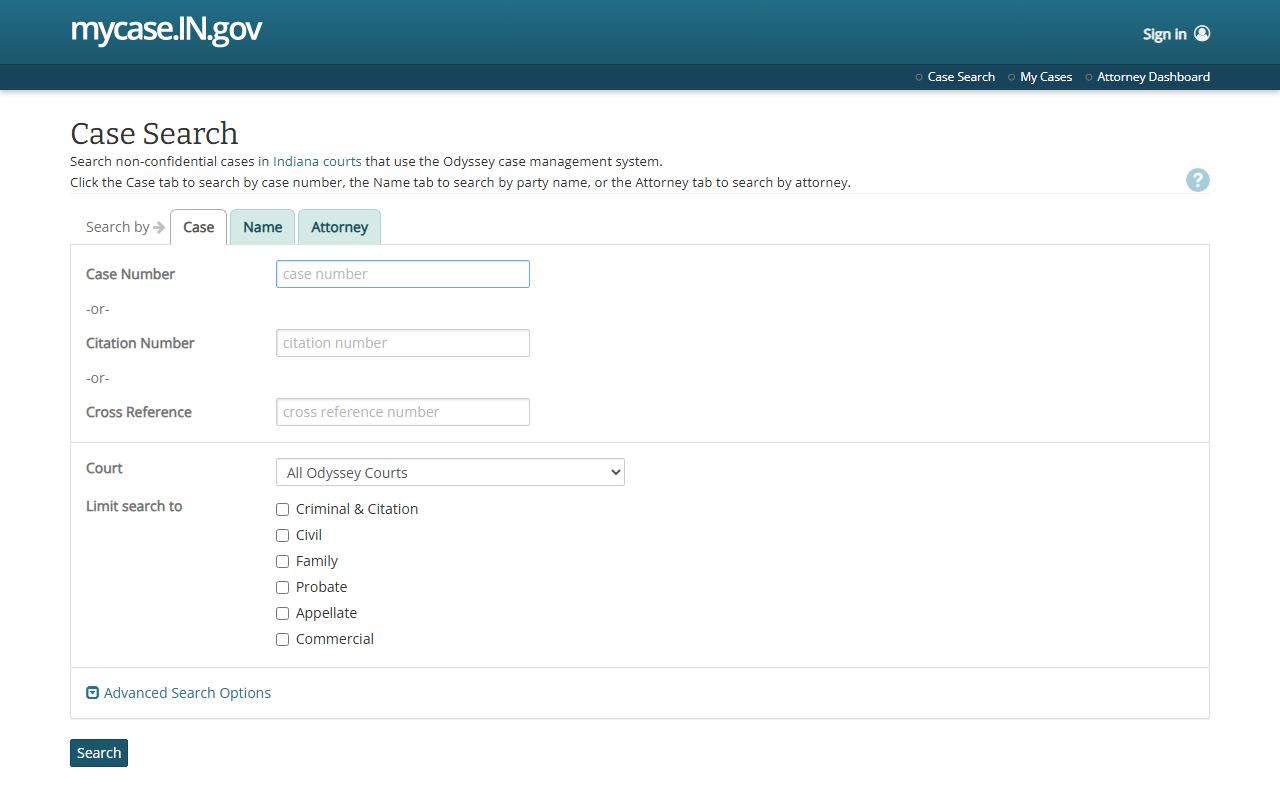
Use the portal for case records, not for jail population status. If the person is newly booked and no case appears yet, the jail roster or jail phone line may update before the court case is visible.
| MyCase Field | Type | Required | How It Helps After an Arrest |
|---|---|---|---|
| Case | Search tab | No | Search by case number, citation number, or cross-reference number from paperwork or a clerk receipt. |
| Name | Search tab | No | Search by business name or last name, then narrow with first name, middle name, or date of birth. |
| Attorney | Search tab | No | Search by attorney name or bar number when counsel is known. |
| Court | Dropdown/filter | No | Limit results to Warren Circuit Court when available. |
| Limit search to | Dropdown/filter | No | Use the case-type scope options shown by the portal. |
| Status | Filter | No | Choose all, open, or closed cases depending on the search goal. |
| File Date From / To | Date filters | No | Narrow results around the booking or arrest date when common names create too many matches. |
The Warren Circuit Court homepage is the local court gateway for Find My Case & Hearing, hearing calendars, court services, and public court information.
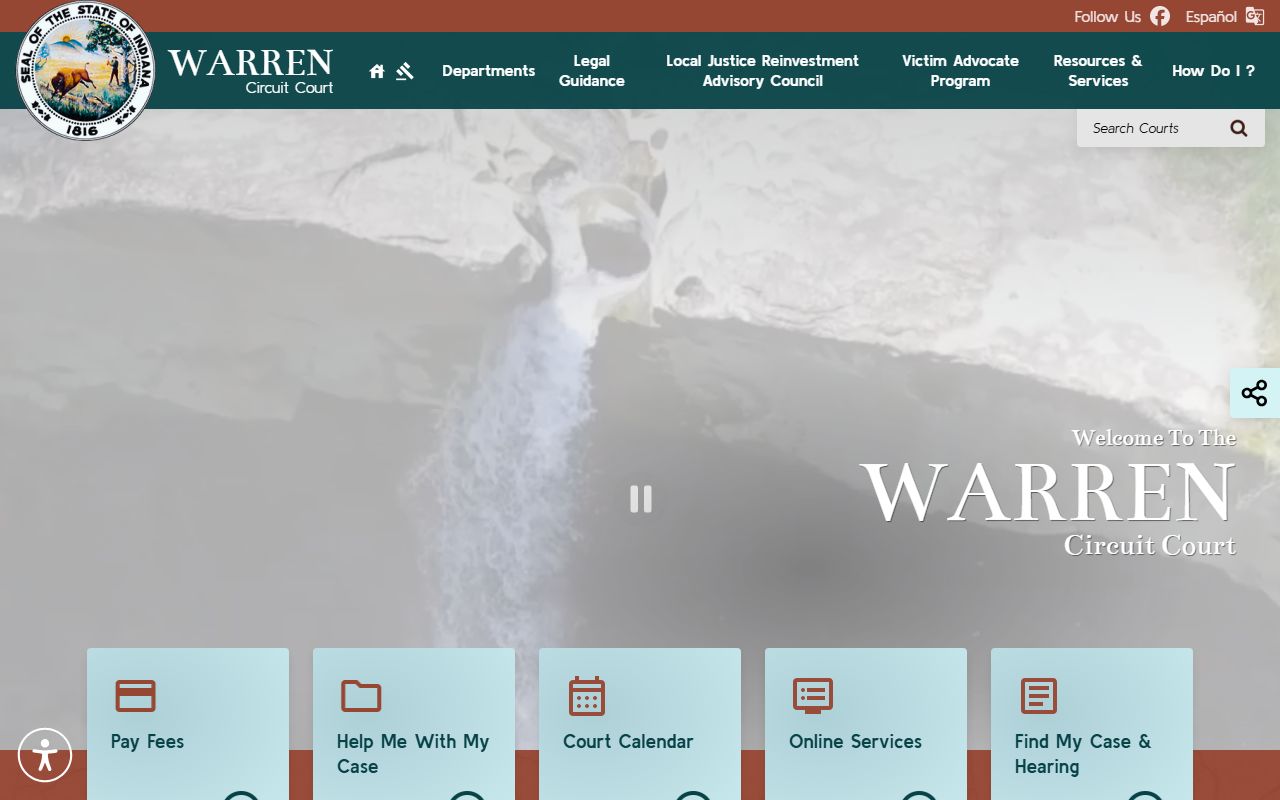
Use the court site to locate public hearing information, then use the Clerk for documents and case-record handling when the document is not available online.
Warren Circuit Court
125 N. Monroe Street, Suite 5
Williamsport, IN 47993
(765) 764-5888 Ext. 2
Fax: (765) 764-1692
court@warrencounty.in.gov
Warren County Clerk
125 N. Monroe Street, Suite 11
Williamsport, IN 47993
(765) 764-5888
clerk@warrencounty.in.gov
clerkcriminal@warrencounty.in.gov
Warren County Prosecutor's Office
223 E 2nd St
Williamsport, IN 47993
(765) 764-4422
Fax: (765) 762-3258
prosecutor@warrencounty.in.gov
Filed Charges After Arrest
Booking at Warren County Jail does not itself decide the final charge. After law enforcement reports are reviewed, the Warren County Prosecutor's Office decides what criminal charges or infractions to file for state-law violations. The filed charging document is what turns the arrest event into a court case record. Indiana criminal cases commonly use a complaint or information, and the Warren prosecutor page also notes grand-jury work as part of the office's duties.
The prosecutor source page in the manifest shows the local office that handles charging decisions after Warren County bookings.
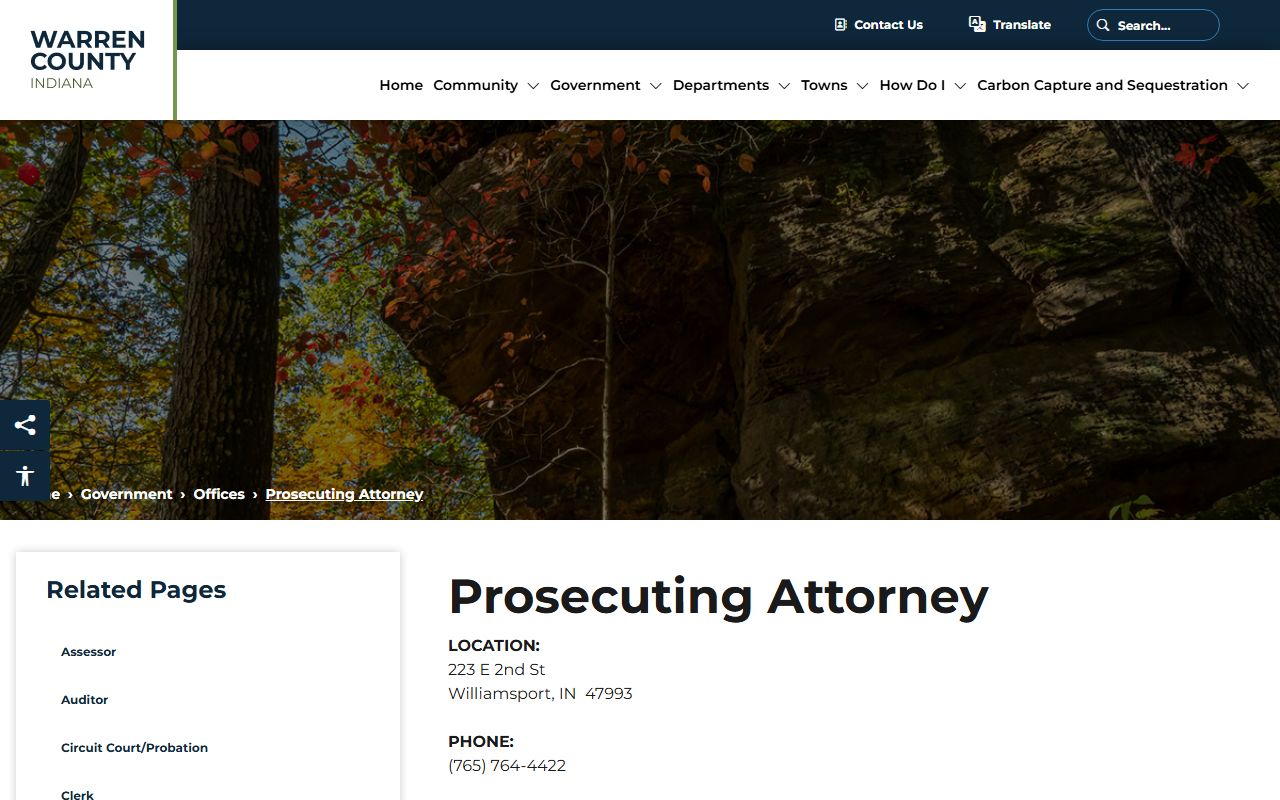
When the jail record and MyCase record differ, treat the court filing as the formal case record and contact the Clerk or counsel before relying on a charge label.
| Document | Filed By | Common Use | What to Check in MyCase |
|---|---|---|---|
| Complaint | Officer or prosecutor, depending on the matter | Allegation or charging document used to begin some criminal cases | Filing date, charge language, probable-cause entries, and initial hearing activity |
| Information | Prosecutor | Common prosecutor-filed charging document for felony and misdemeanor prosecution | Filed counts, offense levels, amended charges, and disposition for each count |
| Indictment | Grand jury | Grand-jury charging route for serious or investigated matters | Indictment filing, warrant activity, bond orders, and later amendments or plea entries |
Warren County Charge Status
Charge status can change as the case moves through Warren Circuit Court. A count may begin as pending, be amended to a different code, be reduced to a different level, be dismissed, or end in conviction after a plea or trial. Warren Circuit Court also has local deferral and diversion information for certain prosecutor-controlled programs, so a pending charge should not be treated as a final conviction until the docket shows the disposition.
| Status | What It Means | Record Caution |
|---|---|---|
| Pending | The charge remains active and has not reached final disposition. | Check upcoming hearings, bond conditions, and whether later entries amend the count. |
| Amended | The filed charge changed after the original filing. | Read the latest count, not only the first charge shown after booking. |
| Reduced | The case moved to a lesser offense or different level. | The final disposition may carry different consequences than the original allegation. |
| Dismissed | The charge ended without a conviction on that count. | Other counts in the same case may still remain active or resolved differently. |
| Convicted | The court entered a conviction after plea or trial. | Review sentence, probation, fines, and any later modification entries. |
| Deferred or diverted | The case may be handled through an eligible deferral or diversion path. | Program completion, prosecutor approval, and court entries determine the outcome. |
Bond and Release After an Arrest
Indiana Criminal Rule 2.6 governs pretrial release decisions statewide. Effective January 1, 2024, the rule says a court should release an arrestee without money bail or surety when the person does not present a substantial flight or danger risk, subject to conditions and listed exceptions. If money bail is used, the court sets the amount and whether bail may be satisfied by surety, cash deposit, or partial cash bail when allowed.
Warren Circuit Court's FAQ gives a local bond route for warrants. If an attorney represents the person, contact the attorney immediately. If no attorney is involved, the FAQ recommends consulting one. When a warrant has a bond associated with it, the bond can be posted first with the Clerk of the Court, and the person can then surrender to the jail to receive a new court date. Court staff may also be called to arrange a date to appear in open court and ask the judge to recall the warrant or release the person on recognizance.
| Bond or Release Type | How It Works in the Warren County Court Route |
|---|---|
| Release without money bail | The court may release the person on conditions and a promise to appear when Criminal Rule 2.6 supports it. |
| Cash bond | Money is paid as directed by the court, Clerk, or jail. Confirm the payment location before arriving. |
| Surety bond | A commercial surety may be used if the court order allows it. |
| Partial cash bail | A court-authorized partial deposit may be accepted when the judge permits that option. |
| No-bond hold | The person cannot be released until the court changes the status or another hold is resolved. |
| Warrant bond | The Warren FAQ says bond tied to a warrant can be posted with the Clerk before surrendering at the jail. |
For bond verification, check MyCase for bond entries, call Warren County Jail at (765) 764-4367 for custody logistics, and contact the Warren County Clerk at (765) 764-5888 for case and payment handling. Sheriff Anthony Pruitt's office is the local jail contact, but the court decides court-ordered release conditions.
Warrants That Lead to an Arrest
No official Warren County sheriff active-warrant search page was located in the reviewed sources. The sheriff page mentions tax warrants as an office duty, but it does not publish a criminal warrant list. For criminal warrants, use MyCase for public case entries, the Warren Circuit Court FAQ for court guidance, the Clerk for case-record questions, and the jail phone line for surrender or custody routing.
Bench warrants often arise from failure to appear or failure to comply with a court order. Arrest warrants direct law enforcement to take a person into custody. Search warrants authorize a search and may not be public during an investigation. A fugitive or other-agency hold may keep a person in Warren County Jail until another jurisdiction acts. Because warrant details can change quickly, verify directly with Warren Circuit Court, the Clerk, the jail, or an attorney before appearing at a facility or sending money.
Charges vs Convictions
A charge is an accusation filed in court. A conviction is a final outcome entered after a guilty plea, verdict, or other qualifying disposition. The difference is especially important in court records after a jail arrest because a booking can happen quickly, but the criminal case can take weeks or months to resolve. Public case access does not mean every allegation was proven.
| Charge | Conviction | |
|---|---|---|
| Stage | Accusation filed after arrest review | Final court result after plea, verdict, or qualifying disposition |
| Decision Maker | Prosecutor files or amends the count | Judge enters the judgment based on plea or trial outcome |
| Proof Level | Probable cause or charging standard | Beyond a reasonable doubt or admitted through plea |
| Record Meaning | Shows what was alleged | Shows what was adjudicated |
| What to Verify | Status, amendments, and dismissals | Sentence, probation, fines, and later modifications |
Sealed vs. Expunged Court and Arrest Records
Indiana public access is shaped by the Access to Public Records Act, court access rules, and IC 35-38-9 expungement law. Eligible arrests, charges, convictions, and juvenile records may be sealed or access-restricted by court order. The Indiana Judicial Branch expungement guide explains the process in more detail, and Indiana Legal Help provides public-facing summaries. Expungement does not mean every copy in every outside database disappears automatically.
| Sealed | Expunged | |
|---|---|---|
| Public Visibility | Hidden or restricted from ordinary public access by court order. | Restricted under Indiana expungement law for eligible records and dispositions. |
| Record Location | The record may still exist with the court or agency. | The record may still exist but access and disclosure are limited by statute and order. |
| Law Enforcement Access | Some government access may remain for authorized purposes. | Authorized access can remain depending on record type and statute. |
| Eligibility | Depends on confidentiality rules, juvenile status, dismissal, or court order. | Depends on IC 35-38-9, waiting periods, case result, and prior expungement history. |
| Practical Step | Review the case docket and ask the Clerk about public access limits. | Use the Indiana Judicial Branch expungement guide or legal help before filing. |
Background Check Considerations
Casual public-record searching is different from a regulated background check. MyCase, jail roster data, Clerk records, prosecutor charging information, and public-records requests can help explain a court case after an arrest, but they are not a substitute for a legally compliant consumer report. A charge may be pending or dismissed, a record may be sealed or expunged, and a jail record can lag behind release or transfer activity.
Important: Do not use jail, court, or custody information for employment, credit, tenant screening, insurance, or any other FCRA-covered decision.
Restricted Warren County Court Records
Indiana APRA allows inspection and copying of public agency records unless an exception applies, but several categories can be limited. Juvenile records, sealed cases, expunged records, protected victim information, medical records, confidential cases, special judge cases, administrative matters, and law-enforcement investigatory records may not appear in the ordinary public search results. IC 5-14-3-5 supports access to specific arrest and jailed-person information, including identity, reason held, receive and discharge or transfer times, and bail or bond if fixed, but it does not make every investigative file or court document public online.
When a Warren County court record seems missing after a jail arrest, check the spelling, date of birth, filing date, and court filter in MyCase. Then confirm custody through the Indiana County Jail Public Portal or Warren County Jail, and ask the Warren County Clerk about public documents that must be obtained locally rather than downloaded from MyCase.